
The Foundation of American Fringe [TE]
Welcome back to the Trenchant Edges, a newsletter about the limits and possibilities of fringe culture.
I’m your host, Stephen and today we’re going to follow up on my recent (ish, lol) writing on conspiracy theories.
But first, a bit of personal fluff: I’ve been doing a lot of deep inner work lately and thinking about how I want to run this thing. Also, I started a factory job last week. I’m going to be ending the monetization of this project once I get my first paycheck on August 14th.
Doing so will clear out a ton of the baggage I’ve had around writing and structuring it and let us focus on the fun stuff.
If you want to support my work the best place to do so is here. Fuck substack.
Hopefully that’ll make all this easier for me to do.
But I digress.
I want to go back to what might be the first bit of really subversive writing I ever read. It’s about why education in the United States sucks shit and I think it’s shockingly relevant to fringe culture.
The fringe is built in reaction to the so-called mainstream.
But who builds that?
The Seven Lesson Schoolteacher
John Taylor Gatto changed my life.

Not so much because he told me something I didn’t know, but because he gave me words to describe a bunch of incoherent, apparently conflicting feelings I’d had as long as I could remember.
Gatto was a schoolteacher. Award winning, even. And when he won the 1991 New York State Teacher of the Year award he gave a speech which became an essay which became several books.
You can read it here.
His argument was that the way compulsory education in the US and elsewhere was structured was geared towards instilling industrial discipline in people, not in educating them.
He said he taught:
Confusion
Class position
Indifference
Emotional Dependency
Intellectual Dependency
Provisional Self-esteem
You can’t hide
He also wrote several books I regarded very highly in high school but won’t be revisiting here. Look them up if this catches your interest.
We’re going to talk about the lessons he described here and how they apply to the creation of fringe culture.
My overall thesis about the conspiracy wing of fringe culture is that it’s a deeply flawed attempt to reject the conditioning society imposes on us. That it’s not an accident that it almost always ends up reinforcing that conditioning, and that there is a way out of it.
Gatto provides us an important element to any scientific analysis: The mechanism.
Why do all these people have the same kind of conditioning?
Because most went through related processes as children.
(There are completely different discussions to be had here about homeschooling and how that tends to fuck with people, but we’re going to ignore it today. See also alternative schooling movements like the Theosophy-inspired Waldorf schools.)
Gatto is aware that his criticisms aren’t exactly universal even within US education, but it’s easier to start the discussion about them as though they were. And since 1992 we’ve only seen the problems he describes getting worse. Most notably the standardized testing boom embodied by W Bush’s No Child Left Behind policy.
1. Confusion
He starts his lessons with maybe the most important one: Decontextualization.
Everything becomes modular, detached facts to be memorized rather than systems of thought. Things become less meaningful.
A good example is in teaching math.
Math is arguably the most universal tool humankind has. It’s applicable to many if not most problems and is very helpful in developing logical skills to work on the rest. The only thing I can think of that’s more universal is language.
But I understand math to be language applied rigorously so that’s not even a different category.
Yet, in all the hundreds of times I asked why I was learning some part of math no teacher ever bothered to figure out a practical example. Probably that’s just that I mostly had bad math teachers, but I don’t think that’s an uncommon experience.
The best I’d get is “You’ll need to know this later.” Which is true, but unhelpful if you’re trying to understand why you should care. So i didn’t care a lot of the time and a substantial part of my adult life has been trying to relearn the math I should have learned in middle and high school.
You’re forced to learn something without a context. Which is weird because the context is as easy to provide as, “How will you do your taxes without this?”. Like, that one thing covers a shocking amount of early math.
Doing your taxes isn’t hard, but it does require both language and math skills that take time to develop.
Decontextualized you have to accept authority at its word. Which trains you to do that more often. We’ll be coming back to that.
Confusion makes you more susceptible to external forces, less able to regulate or plan, and generally unable to organize anything even your own internal state.
Reducing education to mere memorization of disconnected facts makes people unable to think for themselves because they don’t know how to build their own context or do self-directed exploration.
And I think it’s all these qualities that make it so foundational to train people in being confused for social control. Keep your head down, do as your told, and you’ll probably be fine.
This perverts how people rebel as much as it perverts their compliance.
First, you look for some authority to explain it all. For me Gatto was one of those people. And actually, he didn’t do a great job of pointing to the tools I needed to develop intellectual independence.
I did stumble on those but only because I took a very wide search for answers. As I recall he’s particularly a fan of the Trivium method, inspired by classical education which has many good points to it but I find a lot of people who get into it treat it as a magic talisman that makes them unable to commit errors.
(For anyone wondering, I’d point them simply to the question “How do I know that?” and keep doing that until you know stuff. This is called Epistemology. Look for primers on critical thinking and media literacy. It’s a lifelong practice but it gets the goods)
This also hints at the practice to overcome this confusion: Ask what the context is? What even is context? Is the context changing?
Start there and you’ll be better off understanding anything.
This is a problem that the internet magnifies as any whim you have can be chased indefinitely for almost zero cost other than time and energy.
Definitely not something I experience on a constant, grinding basis.
2. Class Position
Gatto’s second lesson is that you will be tracked, evaluated, and positioned in your proper place. You will be graded and those grades will define your value as a person and where you fit in society.
All this is defined by authorities you can’t access, negotiate with, or otherwise persuade.
This isn’t entirely true, but the exceptions prove the rule: The people most able to do those things are wealthier overbearing parents who have the time, energy, and clout to find and push official authorities.
This whole bit is quietly subversive: Gatto is talking about literal classes, like what room a student is supposed to be in, while describing something much closer to Marxist class position. It’s about how we astroturf a meritocracy.
The relevance of this to fringe culture cannot be overstated: Most of us have an inbuilt sense of a vague-yet-all-too-real authority from this very system.
What happens when people with a bunch of built up but unprocessed resentment are pointed at a scapegoat?
3. Indifference
This is the one that really fucked up my life.
Gatto argues the structure of school undermines genuine interest in any subject.
The expectation of teachers of the performance of full engagement with the current class and immediately switching off when the bell sounds only to do it again and again, day in and year out, punishes anyone whose too interested in any specific thing.
“Nothing important is ever finished in my class nor in any class I know of. Students never have a complete experience except on the installment plan.”
This feels a bit oversimplified but I think the broader point is sound.
I spent most of my childhood wondering why my classmates were apparently content to engage with everything so… superficially. I didn’t have the words for it then but the answer is basically they were rationally engaging with a system that produces that result.
I was the weirdo.
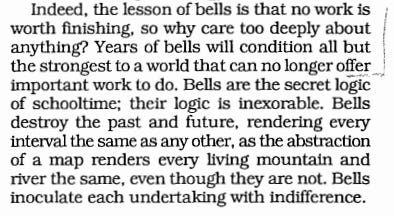
This creates another common lure of conspiracy theory and alternative lore: deep significance. Shit you SHOULD be passionate about. The stakes couldn’t be higher!
And that passion isn’t unwarranted or wrong. It’s just usually misdirected into someone’s bank account or political party.
Trump’s MAGA movement are right that the world is fucked up and we’re ruled by criminals. They’ve just accepted Trump’s favorite scapegoats to the point where they cant’ see they’re supporting those criminals.
Trump didn’t invent the scapegoats, he just built with what was there.
4. Emotional Dependency
Intrinsic motivation is a funny thing. Wanting to do something for its own sake can be extinguished by providing rewards for it.
Extrinsic motivation only exists as long as the incentives that produce it are motivating and present.
No matter how you think or feel about the system, you must subject yourself to its appraisal of you. It’s literally a crime to avoid. Only the bad kids would even consider that.
You’re not a bad kid are you?
You can view the entire education system as a stack of layers of attempted cybernetic control. Changing outputs by changing inputs.
That sounds sinister but you can do that with most social systems. And a lot of it is well-intentioned. The problem is it also generates a huge amount of emotional baggage along the way even for so-called “good kids”.
A ton of corporate cultural production is built to interface with this and expand it. Turning wounds into profit-centers for any number of bait and switch schemes.
This kind of thing is a big part of why conspiracy theory enthusiasts clump around influencer fandoms. They’re using a parasocial relationship with an Alex Jones or Lue Elizondo to both entertain and satisfy emotional desires they can’t handle better elsewhere.
5. Intellectual Dependency
In this lesson Gatto talks about how the boundaries of acceptable thought are defined and enforced by teachers on behalf of whoever sets the curriculum.
Teachers generally have authority to define what is and isn’t true and within their classroom it’s difficult but not impossible to challenge them on this. And because kids are very specifically trained not to do it, they’re usually very bad at even trying. I certainly was.
Success and failure are defined by how little friction you provide the system, which turns out to be a proxy for compliance instead of intelligence.
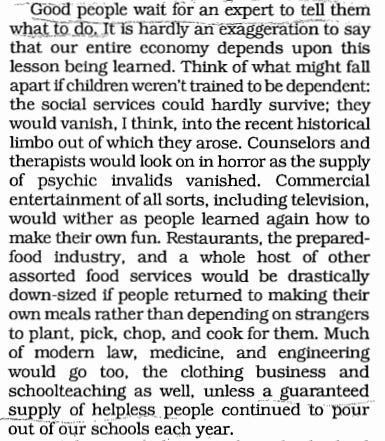
This intellectual dependency issue goes to the core of what I find most disturbing about fringe culture. Relatively few people are seriously thinking for themselves, but shifting which social group they perform allegiance to.
This appears to feel like critical thinking but mostly plays out as people skimming across the surface of topics.
And that’s understandable on a number of levels. Not the least being that attaining expertise is time and energy intensive. Critical thought requires careful processing and reprocessing. These things are luxuries.
And maybe more importantly there are tens of thousands of broad subjects you might want to get into. How many can anyone do in a human lifetime?
Dozens, maybe.
If you’re in ideal conditions.
Navigating the social world is more legible and coherent.
6. Provisional Self Esteem
I feel like the last three lessons are really the same one he’s padded out by taking them from a few angles but the generation of insecurity to make incentive manipulation more effective is certainly an important topic.
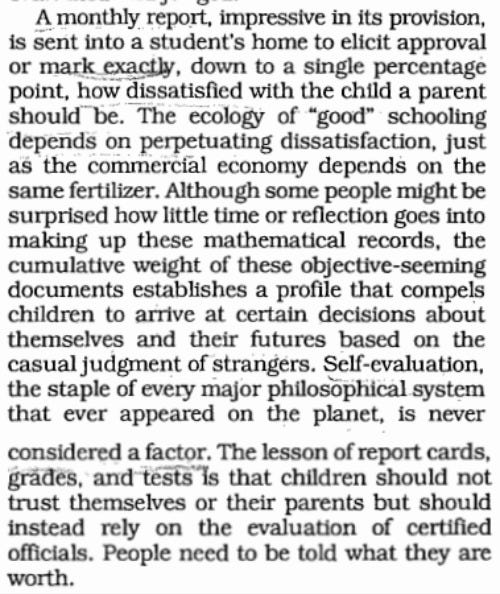
“Self-Evaluation, the staple of every major philosophical system that ever appeared on the planet, is never considered a factor.”
And this is the crux. If you want to accomplish anything of worth in the world you need to develop your own sense for what worth is, how you might do it, and what the process might be.
Chasing external rewards will get you a certain amount of social approval but isn’t durable. The classic relevant example here is the high school football star who isn’t good enough to go pro. But even among pros that’s a job with a shelf life and even I know dozens of former athletes who faced real problems after retirement.
If you’re alive long enough you have to figure out what’s actually important to you and how you want to live.
I’ve known people who didn’t even start that until after they retired from corporate jobs. Hideous waste of decades, however much shareholder value it produced.
All this goes into the way consumer economics cultivates janky people who need to buy stuff to fill their uh holes.
Conspiracy theories and the occult are just a moderately less popular way to do that.
Recent converts to this or that theory are eager to prove to everyone that they know their stuff and can’t be persuaded out of their new ideas. That justifies their decisions. And being insulted or criticized usually only is proof they’re right.
As Alex Jones likes to say, you don’t get flak if you’re not over the target.
7. One Can’t Hide
Surveillance is normal, inescapable, and attempts to change or subvert that are inherently proof of ill-intent.
As we know from the Hawthorne effect, being watched changes how people behave. It was named after years of productivity study at the Hawthorne Works Factory in Illinois in the 1920s found that making workers feel like they’re being watched is the thing that most improved productivity.
Given the massive increase in surveillance in our world since 1992 I don’t feel much need to explain what you already know and regularly experience.
He ends this lesson with the following:
Children will follow a private drummer if you can’t get them into a uniformed marching band.
8. Parts 2 & 3
The second half of the essay goes into detail about what this regimentation has cost us as a society, why it seems inescapable, and the reduced social mobility that came with it.
Part 3 expands on that and talks about, well, fairly poor options for changing it. I don’t really want to go into why his idea of free market education just isn’t going to work. Charter schools have performed the experiment and their quality is as hit or miss as other forms of education and no less teaching his 7 lessons.
Gatto’s got a strong libertarian streak that makes him ignore how the market is the ultimate nexus of the problems he’s talking about.
Despite that his outrage at stripping the majority of people living here of the chance to find their own genius is real.
And I think he caught the root of how the US’ declining social mobility in the 80s and 90s was intentional. He’s just missing the bigger picture: That social mobility was always provisional. In the early colonial era he champions for its superior opportunities for education, he elides over the land theft and slavery that enabled it. Not quite ignoring those things but not giving them the weight they deserve.
In either case, I don’t know how to fix education any more than Gatto does.
He does make a compelling case for how many trends we see in adults are cultivated by the systems we’re told will educate us in what we need to live and how many of the promised solutions will simply extend the harm done.
The biggest school reform package of my life, No Child Left Behind made every one of these lessons worse.
The Purpose of a System is What it Does, as the good book says.
Wrapping Up
In writing this after spending so much time with pseudoarcheology, I’ve basically come to believe that guys like Graham Hancock aren’t shadowboxing Academia so much as average people’s educational trauma.
If you don’t know academics, it’s very easy to just assume he’s right because your experience with education does tell you that educational authorities are close minded assholes who never even consider anything taboo.
It feels right.
And even if you do know academics you almost certainly know someone who fits that description because there are plenty of academics who are like that. Because, you know, that’s how some people are and academics aren’t magically not people.
Even if most don’t. Which has been my consistent experience over 20 years.
This is a point of contention between myself and a lot of other fringe people because, well, my experience is if I want to bring up a crazy idea with an academic and I present it well, they’re going to have a nuanced and thoughtful conversation about it as long as time allows.
And a decent chunk of that is just… not accusing them of being ontologically evil or insisting that the idea needs to be treated with kid gloves just because I like it. Maybe asking a specific question that relates to their expertise.
Basic, “Think about your audience and write for them” stuff.
So much of this is people being conditioned to stop thinking of each other as people, but as symbols of some wicked forces.
We’re enmeshed in forces we do not understand and often use cruelty to each other to cover this obvious fact up.
If you’ve made it this far, pat yourself on the back for still having an attention span and take a breath.
inhale
exhale
Alright.
So, my new job started a couple weeks back and it’s physically demanding enough that it was hard to finish this up.
But I’m adjusted and with a bit of luck that may mean I now have a way to unfuck a lot of the inputs into my own failure patterns.
I have no idea what that’s going to look like on the other side.
I hope you’ll join me in finding out.
See you soon.
-SF